
Gladwin Parole and Probation Compared
Both terms describe supervision in the community, but they begin at different points. Michigan parole normally follows a state prison term. The Michigan Parole Board authorizes parole, and the Michigan Department of Corrections, or MDOC, supervises it through Field Operations Administration. Probation is ordered by a court. It may follow a county jail sentence or be imposed without a state prison commitment. That distinction determines which record should be checked.
A Gladwin County Jail exit record can show that a person left the local facility. It does not establish parole. An OTIS status of “Parole” supports departure from state prison into MDOC supervision. An OTIS status of “Probation” confirms state probation jurisdiction but does not prove a prior prison release. The judgment in the related court case explains the sentence.
| Question | Parole | Probation |
|---|---|---|
| How it begins | Release from prison under Parole Board authority | A court imposes community supervision |
| What it proves | The person left prison but remains under MDOC control | The person is serving a court-ordered community sentence |
| First record to check | OTIS status, Date Paroled, and Location | OTIS for state probation, or the sentencing court for district probation |
| How it ends | MDOC discharge, not merely prison release | Completion or discharge under the controlling order |
- Parole
- Supervised release from state prison while MDOC authority continues.
- Probation
- A court sentence served under conditions in the community.
- Discharge
- The formal end of the sentence or supervision authority.
- Absconder
- A status indicating an alleged failure to remain in contact or comply with supervision.
Verify Gladwin Post-Release Supervision
The Michigan Offender Tracking Information System, commonly called OTIS, is the first public check when MDOC jurisdiction is plausible. It covers current prisoners, parolees, and state probationers, as well as people normally displayed for three years after discharge. It does not cover a person whose only sentence was in the Gladwin County Jail. Set the search status to ALL so a discharged record is not hidden.
- Search by the six-digit MDOC number when known. Otherwise, use the full name and narrow the results with the available identity fields.
- Open the matching profile only after comparing details. A shared name is not enough.
- Read Offender Status and Location together. “Parole,” “Probation,” and “Discharged” answer different questions.
- For parole, compare Date Paroled with the current status. Date Paroled shows prison departure, while discharge shows the end of MDOC authority.
- Open the Location link to identify the assigned office. Supervision may move, so the nearest office is not always the correct office.
- Confirm time-sensitive details with the assigned MDOC office or the sentencing court, subject to disclosure limits.
The official OTIS search screen shows why the Status field matters for Gladwin County probation and parole research.
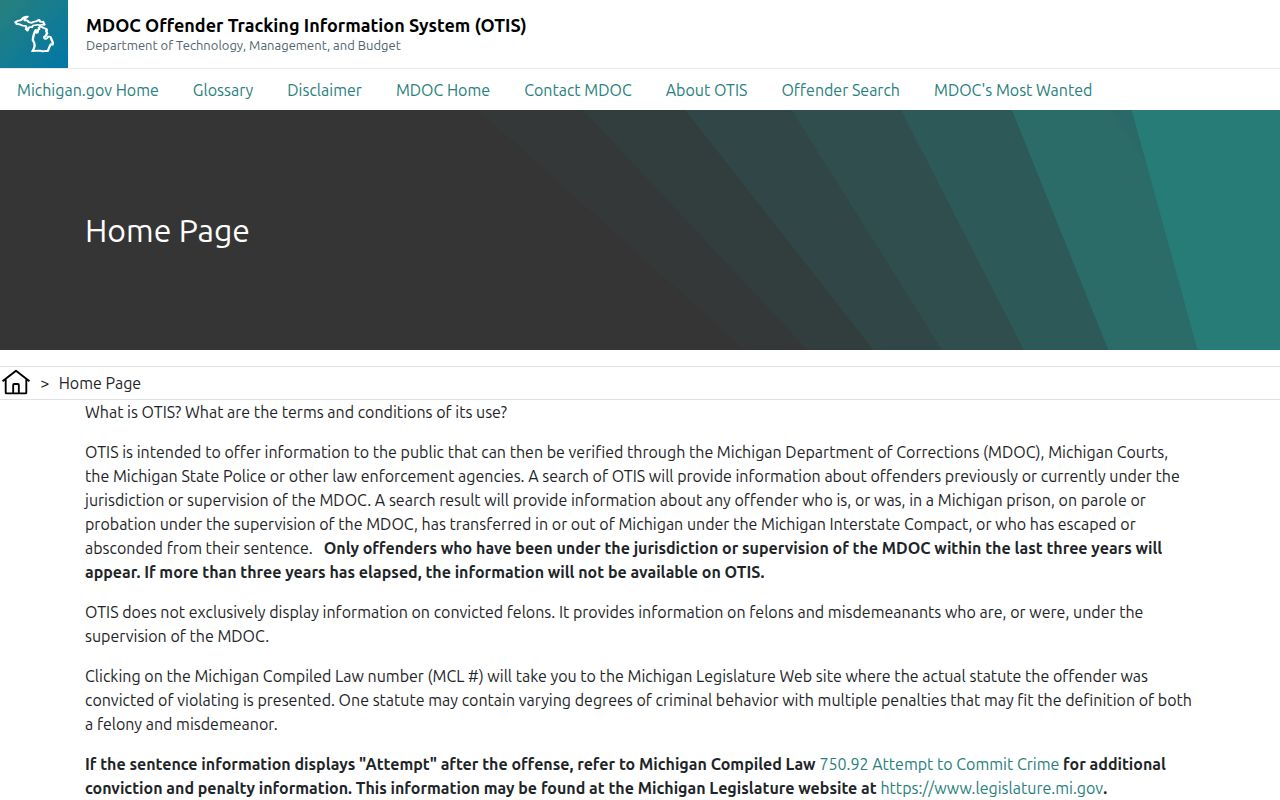
OTIS is not a live county jail roster. A person released from Gladwin County Jail after a jail-only matter may never appear there. In that case, use the sentencing court and the county release record covered in the Gladwin County released inmate search.
Important: A Date Paroled confirms a prison exit into supervision. It does not mean the sentence has ended.
Gladwin Probation and Parole Office
The official MDOC Region 5 directory names a local office for people assigned to Gladwin County. Use OTIS first because assignment can change. The Location field may point to a different field office if the person moved or supervision was reassigned. The Gladwin office is a sound verification and correction route only when it is the assigned office.
Gladwin County Parole/Probation
555 W. Cedar Avenue, Suite BGladwin, MI 48624
Phone: 989-426-6914
MDOC Region 5 Field Operations Administration
The Region 5 office directory is the source for the Gladwin address and telephone number.
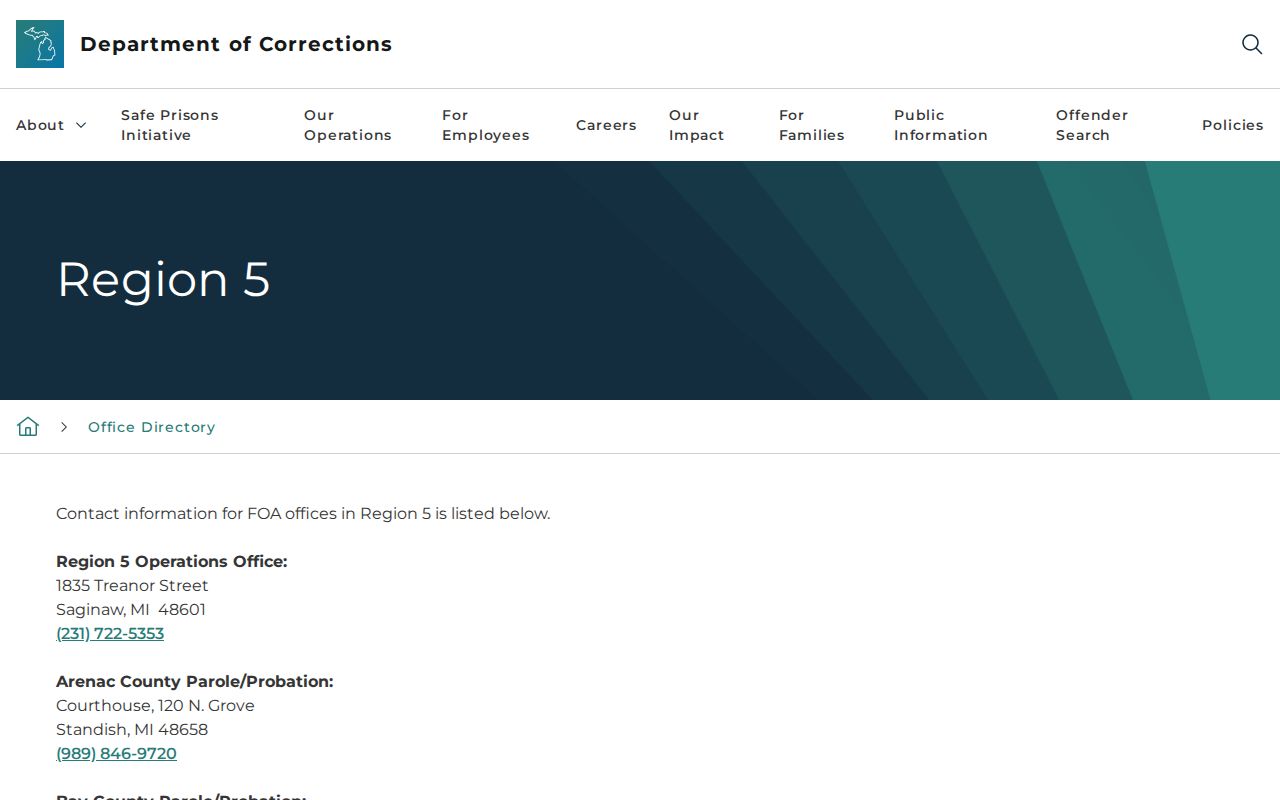
Region 5 includes Arenac, Bay, Clare, Gladwin, Gratiot, Isabella, Midland, and Saginaw counties. That broad coverage is another reason to verify the Location entry instead of assuming an old Gladwin case still has a Gladwin reporting site.
Gladwin Probation Has Two Paths
Gladwin has a useful local distinction. The 80th District Court separately lists a district probation contact at 989-426-6913. That court channel is not the same as the MDOC Gladwin County Parole/Probation office. When the supervision source is unclear, locate the judgment and determine which agency the court assigned.
The 80th District Court handles misdemeanors and the first stage of felony matters. Felony proceedings move to the 55th Circuit Court after the district stage. A court record can identify a probation sentence, its orders, and later case events. OTIS is the better public route for state supervision. Neither database should be stretched beyond its role.
Ask a narrow question when calling. Confirm whether the office supervises the named person, whether the public status is current, and where a records correction should go. Staff may limit what they disclose. Do not treat a lack of phone confirmation as proof that supervision ended.
Note: A court probation contact and an MDOC field office may sit in the same local system, but their records and authority are distinct.
Gladwin Supervision and Absconder Status
An absconder entry signals an alleged supervision or whereabouts problem. It is not a discharge. It also does not invite a private person to approach or confront anyone. Check OTIS and contact the assigned office for the record’s meaning. MDOC lists an Absconder/Escapee Tip Line at 517-755-0855 and advises people with relevant information to contact law enforcement.
No separate official Gladwin County named-person absconder list was found in the research sweep. That means a social post, rumor, or old court entry should not replace the current state record. A warrant, violation allegation, hearing, and final decision are separate events. The public profile may also lag an office action.
MDOC contact information provides the state correction route. For an error in a supervision or absconder field, start with the assigned field office. A court-derived error belongs with the sentencing court. This split keeps the correction request with the office that created the disputed item.
Gladwin Release Programs and Supervision
The Gladwin County Sheriff lists education studies, substance-use counseling, mental-health classes, health care, and chaplain or clergy services inside the jail. Those are in-custody programs. The official jail page does not describe them as a county reentry office or promise that they continue after release.
Post-release needs and supervision questions therefore follow a different path. An assigned parolee or state probationer should use the MDOC field office shown by OTIS. A court probationer should follow the sentencing court’s instructions. The jail remains the source for the local booking and release episode, not the source for a later state supervision assignment.
This boundary matters. A service received before exit does not create proof of enrollment after exit. Likewise, contact with a field office does not supply the county jail’s actual release time. Each agency can confirm only the part of the record it owns.
Correct Gladwin Supervision Records
The right correction path depends on what is wrong. MDOC directs court-derived errors to the sentencing court. Those may involve the judgment or data taken from it. A disputed parole, probation, office-location, or absconder entry should begin with the assigned field office. General OTIS data concerns may also be sent to CorrectionsInfo@michigan.gov.
Gladwin County publishes no specific jail procedure for returning identification, property, or medication at release. Ask the jail about the actual booking rather than assuming another Michigan facility’s practice applies. That question belongs with the jail, not the parole office. The same source-by-source rule applies to records: Sheriff for the jail exit, court for the judgment, and MDOC for state supervision.
Keep the exact profile, field name, and date checked. Avoid sending more personal data than the office needs to distinguish the record. If a conviction has been set aside, MDOC states that it removes the OTIS record after receiving the required legal authority. The sentencing court remains the place to confirm the public status of the case.
Gladwin Parole and Probation Discharge
Supervision ends through discharge, not through a missing search result. OTIS normally retains a discharged person for three years after the discharge date. A person can later disappear from the public search even though the prior sentence and discharge records still exist. Older matters may require the sentencing court, MDOC Records Retention, or a focused MDOC Freedom of Information Act request.
For parole, Date Paroled marks the move from prison into supervised release. Maximum Discharge is a sentence-related field, but the profile’s status and discharge block should be read together. A formal MDOC Discharge Certificate is stronger evidence that state authority ended. For probation, review the latest court order and the supervising agency’s record because amended orders can affect the term.
Michigan parole authority is governed in part by MCL 791.233 and 791.234. Michigan FOIA, MCL 15.231 through 15.246, provides a route to request releasable public records, subject to exemptions and fees. Neither law turns a public locator into a complete historical archive.
Note: “Released,” “paroled,” and “discharged” are not synonyms; each marks a different event and must be tied to the agency that recorded it.